
Friday 30th July
Ian here: I arrived in Mapuordit late today after around 48 hours ‘on the road’ – Sydney/Dubai/Nairobi/Rumbek/Mapuordit, including a brief overnight stay at Bethany House in Nairobi. Not the easiest place to get to, but, there again, not huge queues of people wanting to get here!!
A couple of the Mapuordit sisters I had met last year were also at Bethany, and over dinner the three of us and one of the fathers polished off a nice Barossa Shiraz I had brought for Anne – sorry dear – all in the interests of reducing luggage weight, of course! They all have to come ’out’ on a regular basis, and this was such an ‘outing’.
Sister W---- told me that July is known as the ‘hungry month’ in Mapuordit. People have usually exhausted their supplies from last year’s harvest, and the new harvest is not due until August. So, there is a lot of hunger about and it can therefore be a depressing time to be here.
Anne’s probably mentioned this before, but because S Sudan has no postal system, ‘stuff’ piles up in Bethany House, and anyone coming into Mapuordit is gently persuaded to fetch mail, needed equipment & a host of other things (I’d better be unspecific.....!).
True to form, when I crept downstairs at 5am for the journey to the airport, there was a small mountain of ‘stuff’ on the dining table for me to take ‘in’ (people talk about going ‘in’ and coming ‘out’ of Mapuordit, and this perhaps says volumes about the experience!). Fortunately, nothing too heavy to add to the 30kg I already had....
One of my ‘parcels’ worth mentioning, and which illustrates the difficulties of a lack of postal system, was an envelope of documents needing the Bishop’s signature (administration is done in Nairobi but he’s now based in Rumbek).
I was greeted by him on the edge of the airstrip at Rumbek (and also by some strange gaunt woman who said she was my wife....), he relieved me of the envelope, signed the papers and handed them in the envelope to one of the Sisters who was going ‘out’ to Nairobi on the plane I had arrived in, its propellers still turning!!
True express mail! Ink on the papers was probably still wet when they arrived back in Nairobi 4 hours later!
Anne had various ‘jobs’ to do in Rumbek, ranging from produce shopping in the market to delivering cash to one of the outlying units of the hospital (HIV) to a banking task.
The banks, however, were closed for a public holiday to mark the anniversary of the death of John Garang. He is a local hero, the former leader of the SPLA (Sudan People’s Liberation Army), killed in a mysterious helicopter crash shortly after hostilities in the civil war ended in 2005. Huge event here.
We visited the orphanage run by the Sisters of Charity who had looked after Anne so willingly last year when she fell ill in Rumbek, coming to meet me - some of the severely malnourished babies we saw last year are now a picture of health!
Next door to the Sisters’ compound, we were waiting at Pan Door (House of Peace), a Church conference centre; another of Anne’s ‘jobs’ was to take some passengers, who had been on a conference, back to Mapuordit. A Father who works for Radio Good News, an FM station run by the Church, asked to interview Anne about her experiences in Mapuordit – all in a day’s work!! Even I scored an interview, based on my extensive knowledge of Sudan, one hour after my arrival.....
Now, back to this gaunt woman who was there to greet me at Rumbek...................yes, the photos you’ve already seen on the blog do not lie and the beans & rice diet has taken its toll. But she’s well, if tired – long days, and a good deal of misery around, especially with malaria affecting children.
Some of that misery was seen on the road from Rumbek to Mapuordit. An important government official in the Roads Dept crashed his Land Cruiser into a mahogany tree on Wednesday and received serious injuries – he was taken to Mapuordit (which, by far, provides the best care in a wide area) but succumbed.
On our journey, the grieving relatives were fetching the body back in a car bedecked with tree boughs; we then passed the scene of the accident – the mahogany tree barely dented, but the Land Cruiser V-shaped.
By the way, for lovers of Anne’s blog style, don’t despair – I won’t let her off the hook! We’ve yet to agree how to keep it going whilst we’re both here – I’m amazed she’s been able to keep it going whilst here on her own as there is just so much sickness around. Pauline was called out twice last night for difficult births and Anne assisted with one.
Wednesday, August 4, 2010

Tuesday, July 27, 2010

Birthday cake
Monday 26th July
Pauline and I marked the exam papers last night for the course ‘Professionalism’ for our nursing students - they all passed, top mark 85% and lowest 51%, all very happy!! Good to see your words coming back to you on paper. They really are a bright group, I do hope they will all do well. Let’s hope this course will be a launching pad for them.
They will probably all need to go to another country to further their education; as far as I know, there is only one university in North Sudan and a new one in the South in a place called Wau (think that is how you spell it), but it is just starting up, so not sure what faculties it has yet.
I hope that perhaps some of the local students will stay on here at the hospital and help to build up the nursing side. It is a constant battle to get the nurses to understand what ‘nursing‘ is all about.
Two students are already asking if I can take them home with me so they can get some education. I try to explain about visas, passports, university entrance exams, funds. Don’t want to be negative but it is a big ask, to sponsor. The hospital at the moment (with funding from donors in Australia and Italy), is sponsoring 5 people who all worked here.
One, a nurse (Daniel), who has gone on to do a diploma in ‘public health and clinical medicine’, is getting to the end of his first 9 months (3 yr course). When he finishes he will be able to diagnose, treat and prescribe. It’s in a place on the border with Uganda called Meridi. He is doing really well, we are told. Last year he was the nurse that always wanted me to show him the different anatomy and physiology programs I had on my computer. Such a bright man! He will come back and work here for at least 2 years when he has qualified.
Then another boy has been sent for a 2yr course to get a laboratory qualifications; he is due back for a practical period next Monday, so we are all looking forward to greeting him and seeing how he is going to go, and what new tests he can now perform which he could not do before. We are very limited in our pathology investigations. One reason is, up to now there has not been the training and another which still exists, is the lack of reliable electricity. We cannot culture anything to see what is growing, so just have to treat by looking, smelling and ‘gut feel’ as to which antibiotic to give. If, after a week, things have not improved, we change the antibiotic. Perhaps not very good for the immune system but it’s all we can do here.
The other three are all nurses from this hospital doing this course I am teaching. Two are in their second year and the other is a man called David who was the in-charge on the Children’s ward last year, and who has joined the school this year. So, the hospital is still paying their salaries while they do the course. Then, we hope they will come back to work here. Eventually, it has to be a hospital that is run by Sudanese people, for their people.
It was the boss’s birthday yesterday, so he held a party for all the expats, brothers, fathers, sisters - there were about 30 of us. It was lovely, one of those balmy African evenings, warm, red sunset, lots of loud frog sounds, some drumming from the drum practice in the school.
Some interesting food - one dish, I asked one of the brothers what it was, as it was getting dark so hard to see. He said ‘intestines, and this one is beans, this one is lentils.’ I sort of just had the gravy which was tasty on the beans…..
When it was time for the cake (the brothers have a wood oven, so they can bake), it came out from the kitchen, African style in a procession. All the Africans sang and danced it to the birthday boy. With lots of those loud African ‘cat calls’ - sound much better than a cat - it was great!! I did not know how well the brothers can dance, great movers, particularly the locals.
Late night, 11pm.

Improvised signage at the Liberty Loo

'A way to go!'

Zebra poster
Thursday 22nd July
This week has flown by - so much to prepare for lessons and work on the ward. After working 3 days a week for years in Sydney, to at least 6 long days a week here, I can feel it.
I am feeling so tired, and there is so much misery here, I don’t know how Pauline does it, day after day, she needs a medal! She did get a gold one for the football, but not quite the same!!
The repeat anatomy and physiology exam went well. They all passed - there were 10 retakes. Next week, I am teaching the renal system…I wonder why me?!
The children’s ward looks great - all the posters are up, so colourful they really brighten it up, hope you can see the photos. Some of the children were a bit frightened to begin with, as they have never seen these animals even though they live in Africa. Most will never have seen a picture book, never mind a poster. They really enjoy getting their height taken, there is a bit of a competition going at the moment!! Thank you, Chantelle of Kids Art, it was a wonderful gift.
The lady with the snake bite has a daily dressing with normal saline soaks and antibiotics IV; I think she will be here for at least 6 months. Her new baby is beautiful, but so small, it lies with her in its goatskin all day. Never heard it cry. The only time you hear any of the children is at medication round when they have their injections.
The new buildings are moving forward despite the rain. The shelter for the baby clinic is nearly completed, so they will now be out of the sun and rain while they wait for the Doctor to see them.
There is also a tea room for the staff being built, as there is only a small hut at the moment, where about 10 people can sit. As there are now about 70 staff, that’s including cleaners & outreach staff, it is a little cramped.
We have a young health worker here just now (for 4 weeks) from Slovakia, so she has taken on the task of trying to explain to the patients and the co-patients how to use the new latrine. We might think this is an easy job, but these people are used to squatting in the bush. To go into a small room and balance over a big dark hole is all a bit strange. Washing also, is another past-time many do not understand, especially the ones from the cattle camps. They normally put dirt and ash on themselves to stop the mosquitoes, so to wash is quite alien. She has a hard job ahead of her.
We found a good visual image on the web which she copied with and without the cross in the circle and put it up appropriately - one at the latrine side, and one at the wash side. Again another problem, we all know what a circle with a red line across it means and we understand stick figures, but this is not the South Sudan world. So, every day, there is a group of people around the latrine, having a talk with a translator, discussing spread of disease and risk of infection. This will have to continue for a very long time as patients, of course, are changing all the time.
Friday, July 23, 2010

Lovely local!

Glamour in the dressings room
Thursday 22 July
Pauline and I were doing teaching with the greens today on the wards, bed baths was today’s lesson. We managed to find two towels and two face washers, the co-patients had the hot water ready. We even had two washing up bowls. This was just so hard last year to do that; you would spend half the lesson time trying to find the equipment - what a difference small things make.
The new medical ward that now has 22 beds is full already (there used to be 16) and we are expecting a car-load of HIV patients today from Yirol a small town about three hours away that has no treatment centre - not sure where we are going to put them.
The last patients that came were so advanced in their disease, there was not a lot we could do for them, in fact 3 have died. Until the people come to terms with HIV and admit that it exists, this problem will continue. Early intervention is essential.
Just had two hours teaching in the dressing room, one patient took about one hour, a man with two gunshot wounds to both legs & upper thighs. Luckily for him the bullets came out the other side without hitting the bone, don’t know how, must have been so close. But what a mess to the legs. It’s surprising what you can do with cotton wool, gauze and bandages. I did have some ribbon gauze, courtesy of a friend of mine back home, which has come in very useful, but alas used the last one today.
Next dressing was a spear wound to the back.
Just when we thought all the dressings were over, a young woman with a new baby arrived (sitting in the wheelchair you brought last year, Ian) with a terribly gangrenous leg.
She had been bitten by a snake 10 days ago in a remote village. Two days later she delivered a baby, much more important. Then we’re not sure what happened, think she might have gone to the local witch Dr, but history poor. Her brother who lives here heard about it and went off to bring her to the hospital. Thank goodness he did, as I’m not sure if she would have survived if she had been left.
With the help of two other nurses, we debrided the leg and dressed it as best we could; she will go to theatre tomorrow to see what can be done. She was just so brave with very little pain relief (no schedule 8 drugs here…).
She has now been to theatre. Good news, I think we can save the lady’s leg, but she will be here for a long time.

Prester John

The ordination
Sunday 18th July
Well, what a day we have had. E------ and I were invited to the ordination of a priest in Rumbek; why not?? I will never get another such invite again, I am sure. He was to be the first new indigenous priest in South Sudan for 29 years. He has been studying in Rome for the last three years, and now has got a degree in theology and masters in divine something, not sure what. He has now returned to his home town to serve the people. It was such a big thing, the people really seem to respect him and are so proud ‘he is one of us’.
His life story was read out from the altar, both in Dinka and English.
He was caught up with the war and found himself in a refugee camp in Ethiopia, where he got a few years of education. He then worked in the cattle camps, then in a shop and studied at night. Both parents had died, so he was helping to feed the other children in the family. He then went to the Comboni School in Rumbek, showed great promise, and joined the seminary. Next, he was sponsored to go on to university in, I think, Kenya.
There must have been at least 1000 people there. Lots of blessings on the new priest John by many, including the bishop. People had come from USA, Canada, and Rome. His sponsor family were there, a middle aged couple from Italy, the smile on their faces said it all.
It was a lovely service and they included his remaining family, who found it hard to accept that this is what their brother wanted to do, be a priest instead of looking after the family cows.
The service started at 10am, so we were up early. The car left at 6-45 am; the problem was that there were only 3 cars going, but there were about 50 people waiting to leap in to the cars as soon as the doors were open!! We had been booked into the brothers’ car, so they made sure we were squished in first. Each car managed to get in about 15 people.
There was a lot of water on the track, as we have had a lot of rain lately. All cars got through, although one got a puncture, one was leaking oil, and our dynamo needed attention when we arrived. The cars have to be so strong on this type of ‘road’ here!
We managed to find a seat under some shade, as it was all outdoors in the grounds of the local school. The excitement in the air was electric, carnival-style. There was a man walking around with a long cow horn with a piece of garden hose on the end of it, blowing it and trying to get a tune out of it (Sudanese version of the vuvuzela!!). Lots of coronation-like flags and plenty of very smart plastic flowers decorated the large stage, which was the altar for the day.
There was quite a lot of laying-on of hands, and blessings from all the saints. This took up about 3 hours, then there were the speeches, another hour. So at about 2pm there was a break to have a feast. We were all allocated classroom numbers where we could get food from.
Guess what was on the menu? You got it!! BEANS and RICE! But there was also beef in a stew and a chapati each, very tasty. I had a chat with the Bishop, who seemed very happy to meet me, with the remark ‘Anne, my special goalkeeper, good to see you again’
After our meal, it was marching bands, hallelujah dancers, choirs, plays, all took place around the altar in front of the new Priest John, who kept jumping up and joining in the dancing, much to the locals’ delight. By 5pm we hit the road home; luckily there had been no further rain, so the track had dried up a little. Late to bed that night, let’s hope that the good priest John can bring some harmony and peace to this country - it sure needs it to face the years ahead.
Tuesday, July 20, 2010

Anne on Childrens ward

Childrens ward with poster donated by Kidsart Qld

None shall pass!!
Friday 16th July
The rain today is so loud that at the moment you cannot hear anything.
Will try and send some photos: this one is great - he is on guard, and the roof he is guarding is on the right, awaiting attachment!!
Sad just now on the wards with so many sick ones.
We are having 150-170 outpatients every day just now. It apparently has never been this busy, maybe yes on a Monday after a weekend, but not these high numbers every day such as we are experiencing now.
The majority with malaria, quite a few with typhoid, and children continue to be admitted with pneumonia and anaemia.
Three days ago, a small baby came in with mother and two siblings; the baby had pneumonia, very congested lungs, and could hardly get its breath. Apex beat uncountable.
The baby has been struggling here for 3 days now. Oxygen from our oxygen separator machine (which only gives a small percentage of oxygen from the atmosphere), and even then it depends on the quality of the room air from which it has to extract the oxygen.
The room air quality must often be low, when everyone wants to get into the room to see a baby in distress. Every drug we have this baby has had, and we have prepared the mother for the worst, but today she had had enough of us all doing things (IV cannulation, oxygen masks strapped to her baby’s face, drugs). She wanted everything removed so she could comfort her child.
Guess what?? The baby is so much better. A mother knows!
Thursday, July 15, 2010
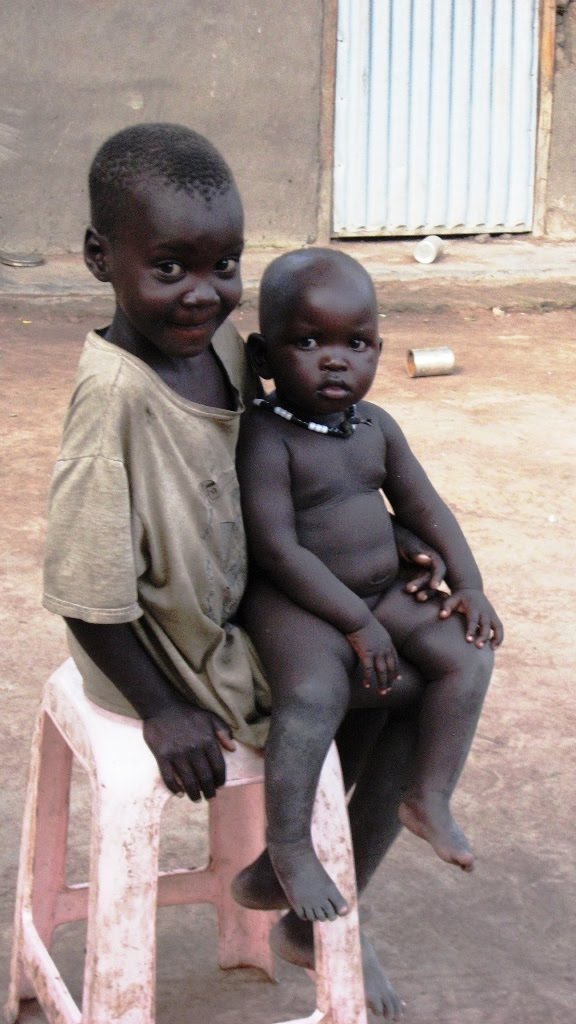
'Me & my bruvver'

'Bees around a honeypot'
Monday 12 July
We were a sad looking bunch at work today. Walking wounded. P---- has a large bruise on her ankle, Sister Pauline has a bandage round her foot, J---- has her calf strapped, and the red area on my left leg is not showing today, so I got away lightly. But proudly around our necks we wore our medallions.
The Bishop had come to the hospital early on Sunday morning straight after Mass to bless the new medical ward. Unfortunately, the ‘Liberty Loo’ was not on the list, so it missed out on a blessing. But I will send you the latest pics - it has now been painted, looks good.
I just wish the patients had a path to get to it - at the moment they have to walk across a sea of mud and builders rubbish. I am sure fixing that will be in the plans somewhere.
Our lovely felled tree has been another source of entertainment this week. The children found a honeypot in it, so have been having a great time, all getting sugar hits - see photo.
Our new students started working on the wards for 1hr every morning, just making beds and damp dusting. It’s good to see them interacting with the patients. They were saying they are feeling like real nurses now. This group are so different from last year; there are 3 girls and 13 men. All have had at least 4 years education, some more. Most are used to studying, just finished school, so they don’t find the exams they have most weeks too challenging.
Pauline and I have been doing some extra teaching these last 2 weeks as they needed revision on a few subjects. It is years since I opened an anatomy and physiology book, never mind teach it. My topics were the ear, the skeletal system, bones, joints and all that is attached. Pauline was covering the digestive system and the skin. They sit their exam next week, so we will wait and see!
Once again, thank you Ronnie, Joan and others for your presentations on many topics. We seem to find one for most of our subjects, so then we just have to simplify them, add extra pictures, and make sure we are covering all that is written in the curriculum.
Yesterday, I was teaching ‘last offices’, or ‘care of the dying and the deceased patient’. It was a really interesting two hours, because I did not pretend to know what the Dinkas do with their loved ones. So I learned heaps. It was a very interactive class.
When you read this, you should realise that they face death so much. Death is so commonplace in Africa and a high percentage happens in South Sudan.
People prefer to die at home, so they are buried close to the house, but in an area that you do not walk past every day. They could not understand the concept of cremation, thought that it was terrible, as was a post mortem – why do you need one? They also believe that if someone dies owing cows, the family will be punished in some way until the debt is paid.
If someone is struck by lightning, it is because the gods are angry with you, you must have done something bad, and the parents cannot grieve for them, or look at them after death. Many believe that they will come back to earth as something else - a tree, or a cow - a bit like the Aboriginal people having a totem. It is the family members that wash the body and wrap it in a cloth.
To let people know that there has been a death in one village, a drum call goes out with a special beat. As it is so flat here, the sound travels well. People will walk to the next village to attend the funeral, so they are big affairs.
The students said that old people (life expectancy in South Sudan is 42 yrs) seem to know when they are going to die and will gather the family around the fire and tell them as much history as they know, so it will be passed down to the next generations.
Nothing is written down. Jewellery is passed to the women in the family, no written wills. When someone dies in the hospital there is no death certificate to give to the family. It is just recorded in the hospital stats that there was a death. At the end of the lesson, I think I learnt more than them - they should set me an exam!!
Subscribe to:
Posts (Atom)
